


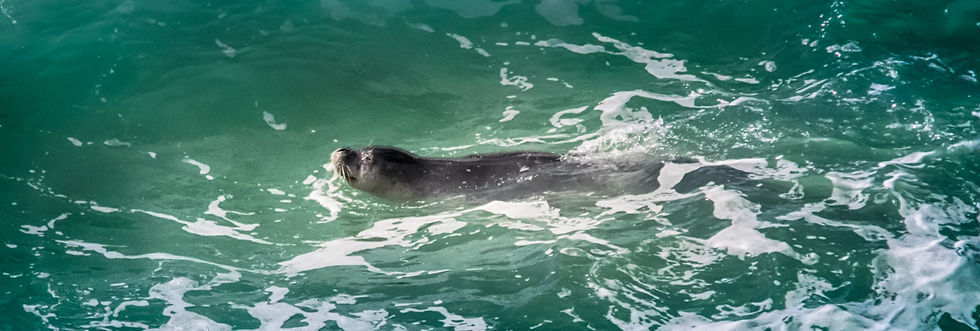

Mediterranean monk seal Research
From Disappearance to Hope: The Story of the Mediterranean Monk Seal’s Return to the Mediterranean Sea
Who can forget the immense excitement when the first documented sighting of a seal in Israel was received?
It happened in 2010, after years of absence and at a time when researchers had almost lost hope of ever seeing seals along the country’s coastline.
Before the establishment of the State of Israel, sightings of the Mediterranean monk seal were far more common. Reports of individual animals—mainly along the coasts of Rosh HaNikra and Tantura (Dor–HaBonim)—were documented from the 1920s and ceased in the 1970s. About 40 years passed since the last sighting in Israel, and only in the early 2000s was the Mediterranean monk seal declared a critically endangered species and one of the 12 rarest mammals in the world.
At that time, the population was estimated at around 500 individuals—a very low number for a mammal with a slow reproduction rate (one pup every two to three years). Models predicted a probability of extinction exceeding 50% within just three generations.
However, contrary to these forecasts, the Mediterranean monk seal population has grown and is now estimated at around 700 individuals, about 400 of which live along the coasts of Greece, Cyprus, and Turkey.
In 2010, reports of monk seals began to emerge from coastlines where no sightings had been recorded for several decades, including Syria, Lebanon, and Israel. That same year, Israel received its first documented visual report of the species: a young female that came ashore to rest in a recess formed in the breakwater of the Herzliya Marina. About ten days later, another individual - most likely a male - was documented on a particularly stormy day near the sea caves of Rosh HaNikra on Israel’s northern border.
These sightings formed the basis of a database we have built since then, comprising more than 110 sighting reports collected along the Israeli coast - from Ashkelon to Rosh HaNikra. Based on the photographs, at least four different individuals have been identified, one of them—the same female later named “Maya”—having been sighted six times at Rosh HaNikra.
How do we know how to identify that these are different seals?
Identification of Mediterranean monk seals is based on fur color patterns (such as the ventral patch characteristic of pups or adult males, or the lateral fur pattern), as well as the presence and shape of scars. Some scars are not permanent, and superficial ones may disappear as the fur molts. Deep scars, however, remain with the seal throughout its life, and mapping them—through repeated observations of a specific individual—helps us identify it along the Israeli coast and in other locations.
This is how we identified the female seal Maya in Lebanon (as shown on page 347 of the paper we published in 2020), and similarly how Turkish researchers identified “Julia” when she visited the Israeli coast in spring 2023. For this reason, when a seal is spotted, it is recommended to photograph it as much as possible.

Each scar was marked with a different color, in images taken between 2010 and 2018. (Roditi-Elasar et al., 2021, Fig 2a)
Regional cooperation to save seals
In parallel with the reports from Israel, reports of sightings also resumed in Lebanon, Syria, Egypt, and Libya in those years, one of which was of a female in advanced stages of pregnancy (in Syria), which indicates active breeding in the region. If until recently it was customary to divide the countries in which individuals of this species are observed into two main groups - those in which breeding is known and those in which it is not - after years of monitoring in the Levant Basin and the Ionian Sea, researchers have come to the understanding that individuals from the main subpopulations in Greece, Cyprus, and Turkey are spreading to new and old habitats. An example of this is an individual known since 2009 in Mersin, Turkey, and identified in 2020 in Lebanon, at a distance of about 300 km, and in 2023 in Israel (at least 530 km). Our Maya, who was observed off the coast of Israel, has also been spotted several times since spring 2020, north of Beirut, and during 2025 we learned that she had given birth to at least two pups in Cyprus. This and other evidence highlighted the importance of improving communication between the various organizations that study the Mediterranean monk seal.
In 2021, researchers from the Delphis Association joined researchers from the following organizations in a joint activity to monitor and conserve the Mediterranean monk seal: the IUCN, which coordinates and leads the project and observations from Lebanon; the organizations Mom, Archipelagos, HCMR from Greece; METO, SAD-AFAG from Turkey; SPOT, Enalia from Cyprus; CBD-Habitat from Spain; and Delphis and the University of Haifa from Israel.
We at Delphis continue to monitor the presence of seals along the Israeli coast through the network of sighting reports and infrared surveillance cameras that we have placed in selected locations, and we continue to work to raise public awareness of the importance of preserving this species and its habitat.

Mediterranean monk seal
Identity card
The Mediterranean monk seal (Monachus monchus) belongs to the family of seals, in the order of marine predators of the class Mammalia. It is a relatively large species: its length from the tip of the snout to the tip of the tail ranges from two to three meters and its weight can reach about 400 kg. The pups are born with an average length of about 90 cm and weigh about 20 kg at birth. Great differences can be found between individuals, which are mainly expressed in the color of the fur - from completely black (in pups) to whitish silver (in adults). However, the most common color pattern is dark brown on the back and whitish gray on the belly. The monk seal is the only species of seal that has adapted...
Integrating the Delphis community into the Seal Project
With the exciting arrival of the monk seal Yulia on the shores of Israel in May 2023, the Delfis volunteer community mobilized in an extraordinary way to protect her safety and privacy on the beaches. Dozens of volunteers from all over the country showed up every day to keep curious people away, document behaviors, and pass on information to the general public and professionals.
This community effort did not stop in July. The Delphis community continues to support the long-term project, which aims to return the Mediterranean monk seal to the shores of Israel - a rare marine mammal that became extinct here decades ago.
With the help of Delphis volunteers, we have so far scanned more than 30,000 photos, taken with cameras we installed in the caves at Rosh Hanikra, in order to document a seal if it appears in them. The volunteers in the community take an active part in sorting, filtering and labeling the photos, under the professional guidance of Delphis and international researchers. In addition, they participate in field activities and assist teams at sea and on land – all of which constitute a tremendous contribution to the project’s research and educational effort.
As the project progresses, it is clear: the return of the seal to Israel is not only a scientific goal - but also a community dream.
The Delphis community proves day after day that public involvement is a real driving force in the restoration of our marine nature.

Delphis information stand, set up on the beach where the mermaid Yulia arrived, 2023