


Delphis summarizes 2025: a year of marine discoveries, groundbreaking education and international collaborations
Updated: Jan 7
From significant observations at sea to a new initiative for regional cooperation: Delphis presents achievements, partnerships and hopes for the new year
The year 2025 marked a leap forward in the activities of the Delphis Association, a leader in the field of marine mammal conservation and marine education in Israel. A unique combination of scientific research, environmental education, and regional collaborations has led to significant achievements, both below the surface of the water and in the education system. Here are the highlights of the past year's activity.

Marine research in 2025: dolphins, cruises and surveys
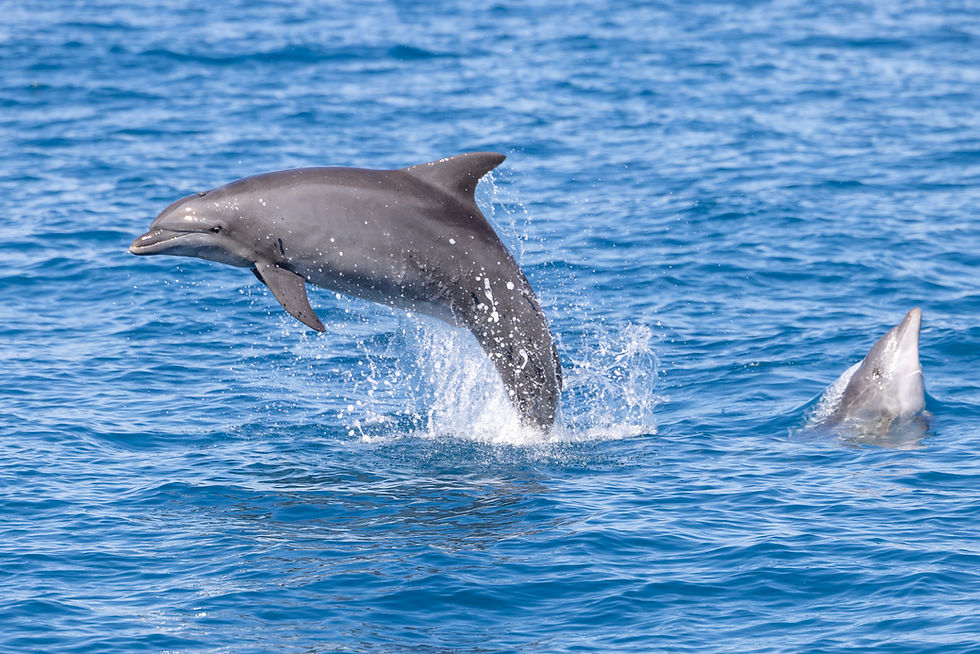
Over the past year, Delphis and Haifa University researchers conducted 49 proactive surveys in Israel's marine space, which led to 25 dolphin sightings, 22 of which were of the common bottlenose dolphin (Tursiops truncatus, the most common in our region) and for only the third time since the beginning of the documentation of dolphin populations off the coast of the country (in the early 1990s), there were also three sightings this year of mixed dolphin pods - of the common bottlenose dolphin and common dolphin (Delphinus delphis). The latter is a species that is classified as endangered in the Mediterranean Sea, and is usually observed in a pod living in the Avtakh Marine Reserve area, between Ashdod and Ashkelon.
Our team sailed for more than 216 hours during the year, covering over 1,170 nautical miles - a testament to the scope of ongoing activity in the field of marine research and monitoring.
Dolphins were observed in about half of the surveys initiated - a record figure compared to previous years.
Cases of strandings: Data, Analysis, and Insights
During the year, 14 dead marine mammals washed up on Israeli shores, including:
- 9 common bottlenose dolphins, the last of which was found on the beach yesterday
- 2 dolphins of the species Stenella psosa
- 1 common dolphin
- 2 Mediterranean monk seals
Of all the strandings, only three individuals were found fresh enough for autopsy. According to Dr. Mia Elasar of the Delphis Association, there was no deviation from the annual average of deaths. What surprised the researchers, however, was the inconceivable figure of two seal deaths.
"In addition to four reports of seals observed on the central and northern coasts during 2025, two dead seals also arrived on the shores of Israel. This is the first time since the beginning of monitoring the innocence of marine mammals in Israel in the 1990s that dead monk seals have arrived on the Israeli coast," said Dr. Elasar . "The first body was identified as a female, and with the help of Dr. Eli Biton and Ron Goldman from the Physical Oceanography Laboratory of the Institute for Marine and Lake Research, who matched the time of the body's arrival to the sea currents in the area at that time, we discovered that the body most likely came from the Cyprus area. We have transferred a DNA sample to the Cypriot researchers and we are waiting to see if they have found a match to females known to them."
The surprising discovery about Maya
The year 2025 brought with it significant breakthroughs in the field of monk seal conservation: In the midst of the restoration work of one of the natural caves in Rosh Hanikra, Delphis researchers discovered from Mr. Harris Nicolaou of the Cypriot Ministry of Agriculture, who accompanied the restoration project, that 'Maya', a monk seal first observed in Israel in January 2010, had come to a cave in northwestern Cyprus at least twice to give birth - a significant discovery that shed new light on what we know about the use of monk seals on the various beaches in the eastern Mediterranean.
"Mr. Harris' visit validated the importance of regional cooperation in the conservation of the seal that knows no borders," said Dr. Elasar. According to her, Maya's observation during the war in the Rosh Hanikra caves confirmed the Delphis researchers' hypothesis that the seals were using caves on the Israeli coast and gave them the impetus to continue monitoring the caves. "We reassessed the placement of the cameras in the caves, prepared with new installations that our team of volunteers (Shlomi Marko, and Dana and Mickey Reininger) designed and adapted, and returned to monitor the caves in the caves in the summer of 2025. Currently, over 30,000 images that documented the caves over a year and a half have been scanned by the wonderful volunteers of the Delphis Association, with the hope that in the next round we will also be able to celebrate the identification of a seal," she added.
The collaboration with researchers from Cyprus to piece together the puzzle of 'Maya's' life joins Delphis' previous collaboration with researchers from Italy, as well as with researchers from Turkey, during the visit of the seal 'Julia' to the shores of Israel in 2023. "This shows us how significant it is to study the regional picture in the case of marine mammals," emphasized Dr. Elasar.

Israel - a hub for marine research, education and conservation
During 2025, we launched the Sea-Beyond project, with the support of the Ministry for Regional Cooperation, to promote professional and ongoing collaborations between the countries of the Mediterranean Basin. In April of this year, implementation of the initiative began to establish a regional center for knowledge, conservation and education in the field of the Mediterranean monk seal, while positioning Israel as a central junction for connecting research, educational activities and marine conservation.
During the first year of activity, a physical, research and educational infrastructure was laid for the project. The first natural cave at the Rosh Hanikra site was restored, drawing on knowledge and experience gained in similar projects in the countries of the region, primarily Cyprus, and a monitoring and camera system was installed in it, which enabled the beginning of data collection and ongoing scientific monitoring. At the same time, a dedicated education program was implemented, teaching and learning materials were developed, a dedicated website was established and professional newsletters were distributed to make knowledge accessible to the public and professional audiences.
Alongside the field activities, the Delphis team held professional meetings with international researchers from Cyprus, Italy and Greece, aimed at sharing knowledge, mutual learning and deepening regional cooperation. In 2026, the project is expected to deepen and expand, increasing the scope of research, restoration and conservation activities, developing additional education and outreach components and deepening long-term regional cooperation.
Environmental Education: When the Students Met the President of the State
In 2025, the Delphis Association continued to develop and expand its educational activities, strengthening the connection between maritime education, civic science, pedagogical innovation, and community engagement.
During the year, educational activities were renewed at the Dolphin and Sea Center, which operated as a national hub for experiential learning about the sea, biodiversity, and the connection between humans and the marine environment. The center hosted educational visits from educational systems from all over the country, including kindergartens, elementary schools, middle schools, and high schools, and offered tours, workshops, and age-appropriate activities that combine scientific knowledge, emotional connection, and nature conservation values.
The Delfis Association's 'Julia Project' continued to operate, for the second consecutive year, in the Israeli education system, and this year deepened the educational engagement with the issue of the disappearance of seals from Israel's shores. It included two national training courses for science teachers from elementary and middle schools, with the participation of teachers from all over the country.
Following the training, hundreds of students participated in research and project-based learning processes, in which they developed creative proposals for restoring seals to Israel's shores. The proposals combined engineering, technological and social solutions, and emphasized systems thinking and the ability to apply scientific knowledge to complex environmental issues. Three groundbreaking proposals were selected as outstanding proposals and presented to the President of the State, Mr. Yitzhak Herzog, as part of the Youth Climate Conference.

Activities for the general public at the Dolphin and Sea Center
Thousands of visitors from across the country enjoyed a unique activity for the whole family this year during Passover that Delphis held at its educational center, the Dolphin and Sea Center, in collaboration with Bank Hapoalim. The activity, which included experiential content and exposure to the organization's environmental work, contributed to raising public awareness of the importance of protecting the sea and marine ecosystems, while strengthening the connection between the organization and the wider community.
During the rest of the year, a variety of audiences visited the center, including teachers, kindergarten children, elementary and high school students, senior citizens, children of employees from large companies, including SodaStream, science center directors, education supervisors, psychologists from the ORT network, families with (and without) children, the mentally ill, volunteers from associations, including the Ecoocean association, Delphis volunteers - who were given a special tour, summer camp children, Iron Dome soldiers, families of the Association of Cities, members of the Ashdod Sea Community, members of the Avocado Community, and more.

On the way to five units of study in marine environmental sciences
In 2025, Ashdod continued to serve as a central focus for Delphis' educational activities, as it is the city where the association's educational center operates and where a unique connection exists between a marine environment, an urban space, and innovative education. The association's activities in the city contributed to strengthening the educational continuum for Ashdod students, while creating an infrastructure for experiential learning, research, and environmental entrepreneurship in the environment closest to their lives.
Within this framework, new educational collaborations have been developed in the city, including a collaboration with the Municipal Technology Center, within the framework of which a unique workshop was developed to study the Lachish River. The two-day workshop, which is intended for high school students and combines field research, technological thinking, and discussion of environmental, urban, and social aspects of the river, is expected to launch in 2026.
In addition, Delphis participated in a hackathon held in the city of Ashdod, in which the city's students took part and developed innovative environmental initiatives, including initiatives to clean the sea, reduce marine pollution, and increase civic involvement in protecting the coastal environment. This activity strengthened Ashdod's position as a leading city in environmental and marine education, and emphasized Delphis' contribution to building a long-term educational infrastructure to foster a young generation that is involved, proactive, and responsible for the environment in which it lives.
As part of deepening the field of educational excellence, the association worked in collaboration with
Citizen science and an active community
One of the goals of the Delphis Association is to make science accessible to the general public. As part of a new initiative to integrate the association’s volunteers into research work, 126 volunteers this year underwent professional training to conduct dolphin surveys off the coast of Israel in the Mediterranean Sea, and took part in a long-term study conducted by researchers from the University of Haifa and the Delphis Association to monitor local marine mammal populations. In total, Delphis volunteers participated in 12 dolphin research cruises this year.
Scientific research and international publications
This year, Three important scientific articles were published, dealing with interactions between dolphin species, the distribution of different ecotypes, and ecological aspects of the Mediterranean Sea:
Bottlenose Dolphins (Tursiops truncatus) Along the Coast of Israel: Abundance and Social Structure
The article examines the
The study, led by Yali Meborach from the Maurice Kahn Marine Research Station at the University of Haifa, and Dr. Aviad Sheinin, head of the station's apex predators department and director of the Dolphin and Sea Center of the Delphis Association, summarized 16 years of research on the common dolphin. Its results show that a stable population of 68–88 individuals lives off the coast of Israel at any given moment, as part of a "superpopulation" that resides here permanently and numbers about 340 dolphins. Of the population, there is a core of 42 "true Zionist" dolphins that remain here permanently.
Ecological interactions and unique resource partitioning between dolphins in the ultraoligotrophic eastern Mediterranean Sea
The article investigates three dolphin species that live in the nutrient-poor waters of the eastern Mediterranean, off the coast of Israel: common dolphin, common dolphin, and Stenella psosa. The study focused on understanding the distribution of resources between the species (who eats what and where), their position in the food web, and differences in feeding behavior and habitats.
Investigating the presence of different bottlenose dolphin ecotypes in the Mediterranean Sea
The study examines whether there are two different ecotypes (ecological types) of the Mediterranean common dolphin – one that prefers shallow water, near the continental shelf, and one that prefers deep water and far from the coast. The study is based on data collected between 2004 and 2019 from 43 different research groups across the Mediterranean. The findings showed that most of the dolphins observed are mainly in coastal areas – that is, they are found in the vicinity of the continental shelf, and there was no strong evidence that the two ecotypes swim alongside each other in the same area. It seems that the population of the Mediterranean common dolphin is probably more ecologically uniform than previously thought.
Looking ahead to 2026
Delphis hopes to complete the permit process for the restoration of the large birthing cave at Rosh Hanikra, expand the new educational program, and strengthen regional collaborations. All of this is out of a deep belief that connecting science, education, and community is the key to preserving our marine environment.
Together with volunteers, researchers, students, and partners, we continue to strive for a future in which marine mammal populations thrive off the coast of Israel in a healthy, diverse, and accessible sea for all of us.
Thank you to everyone who supported and took part in the association's activities this past year and to everyone who continues to follow our work - and see you in 2026!

Comments